Every year on March 24th, World Tuberculosis Day reminds us of both how far we’ve come and how much work remains. Tuberculosis (TB) is preventable, treatable, and curable. Yet today, it remains the world’s deadliest infectious disease, continuing to take millions of lives and affect families and communities across the globe and herein Canada.
The reality is difficult to accept. In a time when medical science has advanced rapidly, no one should be dying from a disease we know how to treat. But TB is not only a medical issue. It is deeply connected to poverty, inequality, access to health care, nutrition, and living conditions. When systems fail, when funding is cut, and when political commitments weaken, progress can quickly unravel.
For decades, global efforts have helped reduce TB deaths and improve access to diagnosis and treatment. But recent years have shown how fragile this progress can be. When investments in global and public health fall, it is often the most vulnerable communities who feel the impact first, including women, children, and people living in low-resource settings and in underserved communities across Canada.
Today, this decline is being driven by major cuts to international assistance, with G7 countries planning to reduce aid spending by up to 28%, including billions of dollars in cuts from Canada. At the same time, the United States has dismantled USAID and left the World Health Organization. All these cuts and divestments have halted health programs worldwide, disrupting TB prevention, diagnosis, and treatment and putting millions of lives at risk. They also weaken the global systems that help protect health everywhere, including in Canada.
This is why World TB Day matters. It is not just about awareness. It is about reminding governments, decision-makers, and communities that progress against TB is worth protecting. It is also about recognizing the people working every day to prevent, diagnose, and treat TB, including community health workers, researchers, advocates, and survivors.
For us, World TB Day is also a moment to come together and take action. One of the ways volunteers and communities across the country show solidarity is by lighting monuments and landmarks in red. These illuminations help spark conversations, raise awareness, and remind people that TB remains a global health emergency and a public health issue in Canada that requires sustained attention and investment.
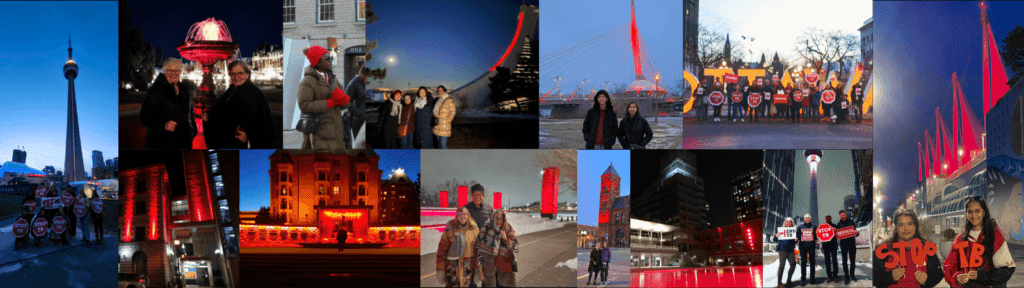
This year, we encourage you to continue this powerful tradition. Requesting local landmarks or monuments to be lit in red is one way individuals and communities can help bring visibility to World TB Day. These moments of visibility help ensure TB is not forgotten and that leaders understand Canadians care about global health equity.
World TB Day is also a time to reflect on Canada’s role in global health leadership. Investments in global health programs, research, and innovation help save lives worldwide and strengthen global health security for everyone. When Canada supports TB programs, it helps ensure life-saving tools reach the people who need them most.
But progress does not happen automatically. It happens when people speak up, organize, and take action together. Ending TB is not just about science. It is about political will, sustained investment, and solidarity.
This World TB Day, we invite you to learn more, raise your voice, and take action. Whether that means requesting a monument lighting, sharing information, or advocating for stronger global and domestic health investments, every action helps protect progress.
Because ending TB is possible, but only if we choose to make it a priority.